Most people see an electrical schematic.
An engineer sees a philosophy.
This drawing is not merely a collection of wires, symbols and terminals. It is the visual language through which engineers communicate intent, logic, responsibility and safety. Every line exists because someone asked a question long before the elevator was ever installed:
“What must happen before the elevator is allowed to move?”
That question is far more important than “How do we make it move?”
The difference between ordinary machinery and life-safety equipment lies in that distinction.
An elevator is one of the few machines that people entrust with their lives without a second thought. Parents enter with children. Hospitals transport patients. Elderly passengers rely on it every day. That confidence is not created by polished stainless steel or elegant interiors. It is created here—on engineering drawings that most passengers will never see.
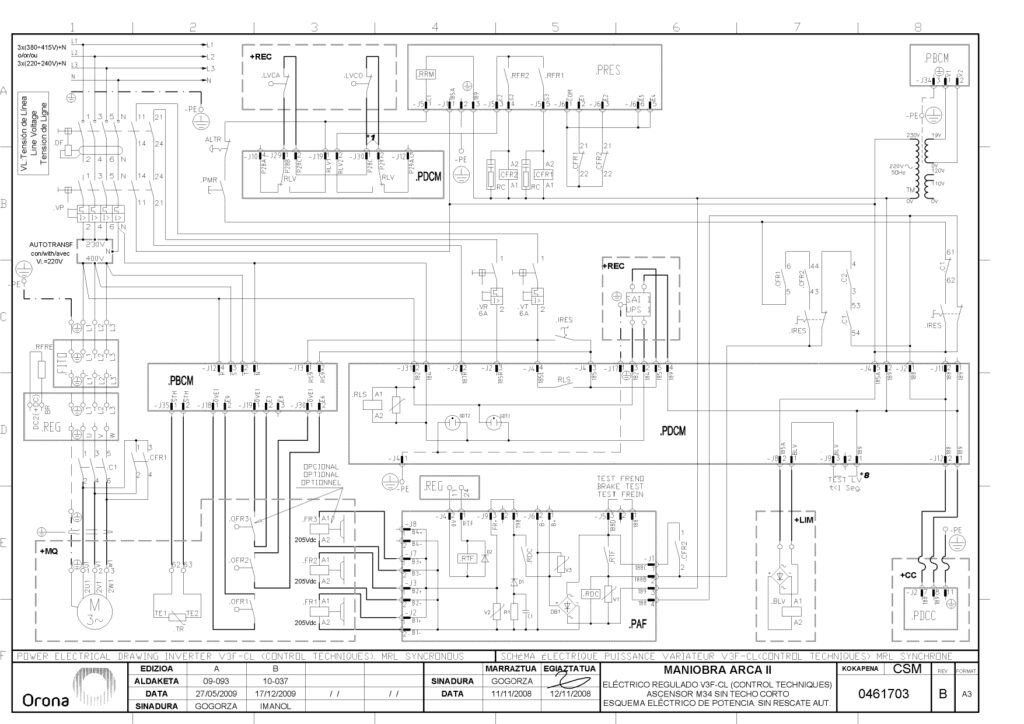
Notice something remarkable.
The schematic does not begin with movement.
It begins with control.
Power must arrive correctly.
Protective devices must be ready.
Safety circuits must confirm continuity.
Commands must be validated.
Outputs must respond exactly as intended.
Only after the system has convinced itself that every critical condition has been satisfied does it permit the motor to rotate.
That sequence teaches one of engineering’s oldest principles:
Motion is never the first objective. Controlled motion is.
A young engineer often looks at a drawing and asks,
“What does this component do?”
An experienced engineer asks a different question:
“Why was this component considered necessary in the first place?”
Those two questions define the journey from technician to engineer.
Every relay represents a decision.
Every fuse represents protection.
Every contact represents permission.
Every terminal represents communication.
Every interlock represents a lesson learned—often from decades of operational experience, evolving standards and countless field observations.
Nothing exists simply because there was space on the drawing.
Another misconception is that engineering seeks complexity.
It doesn’t.
Complexity is expensive to design, difficult to install and demanding to maintain.
The engineer’s challenge is therefore not to create complexity, but to organise only the complexity that is absolutely necessary.
The highest form of engineering is disciplined simplicity—not fewer components, but no unnecessary ones.
That is why a good schematic resembles a well-written argument.
Every element supports the next.
Every decision has evidence.
Every pathway has a purpose.
Remove one essential connection, and the logic weakens.
Add unnecessary ones, and clarity disappears.
Engineering drawings are therefore more than technical documentation.
They are evidence of how a team thinks.
They reveal priorities.
They reveal discipline.
They reveal whether safety was designed into the system or merely added to satisfy a requirement.
Perhaps the most profound lesson hidden inside this drawing is this:
The controller spends far more time deciding whether movement should be prevented than deciding how movement should occur.
Passengers experience only the final outcome—a smooth ride, accurate levelling and reliable operation.
Engineers experience everything that made that outcome possible.
The finest engineering is rarely recognised because its greatest success is to become invisible.
When passengers never think about the controller, it is usually because the controller has already thought about everything on their behalf.
That is not coincidence.
That is engineering.
Is there another part of an elevator you’ve always been curious about? Tell us in the comments—we may feature it in our next article.
Leave a Reply